
Unconventional brains are cheating now. Good.
Your brain failed their format check. Their format can go to hell.

Exciting Reads
The Fractional Operator by Rini Kothari
Practical systems thinking for founders, operators, and executives. Learn how to diagnose bottlenecks, build companies that scale, and make better decisions.
Trigger warning: this article is AI assisted and I am not sorry. If that sentence already upset you, the rest is going to be a looooong day.
Last week a thread started on Substack Notes. Emma Klint wrote this:
“The people most sure about which uses of AI are ‘allowed’ tend to be the ones who never needed it to say what they mean. My brain moves faster than I can type. I write in my second language. AI is the scaffolding I need to take part in this conversation at all. Nobody gets to tell me that’s cheating.”
Then Stephen Scheidell answered:
“Your ideas are your ideas. Full stop. Whenever someone gives me a hard time for brainstorming in chatGPT, I ask whether they wrote the letters on the screen by hand or whether they just pushed a button while the computer drew the letter. I tell them if they’re gonna grief me for using a tool, I’ll give them grief for also using a tool.”
I replied with one line about AI as a sparring tool and promised an article. This is that article, I had the sparring tool check it for holes in my logic, and you are welcome to report me to the AI police. To do so you’ll have to fill a form which is probably a Google Doc, which is also a tool like my AI. You’re welcome.
Now notice who files these complaints. The dyslexic founder stays out of it, and so does the engineer writing invoices in her third language at midnight. The verdicts come from people whose brains happen to fit in the exact format the cookie cutter defined for them.
And before you get mad, I’m not talking about single shot prompt output that replaces the whole thinking process, copy-paste whatever comes out. I’ll get to that.
Oh, BTW: Don’t even get me started on GenAI. People complaining about generative AI and saying it’s theft were just last week dancing to a DJ who’s been making money out of sampling other people’s music without permission for 45 years.
There is a law from 1956 that ends this argument before it starts, written by a psychiatrist who never saw a chatbot and would have shot LinkedIn on sight. Ross Ashby’s law of requisite variety says a controller must match the variety of the system it controls. In plain terms, if you roll too much spaghetti on your fork, you need to open your mouth very wide.
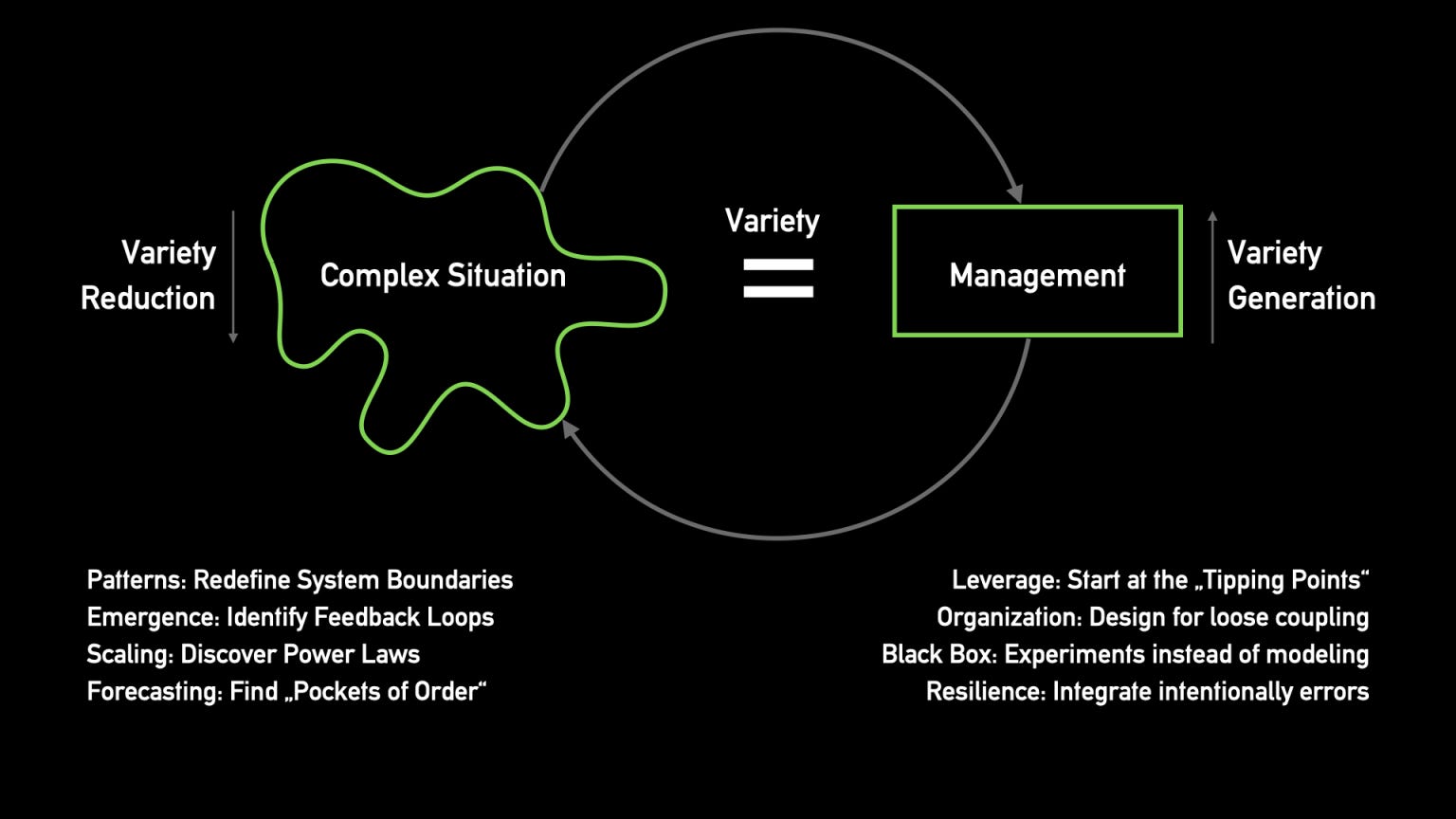
If you read (Over)Thinking Out Loud, you know that Emma’s thinking runs at full variety. Her output channel does not, because typing has a speed limit and English is her second language, so the version of her that reached the page had to be a compressed summary of the version in her head.
When a critic reads her writing and starts sniffing it for “authenticity”, they believe they are auditing the quality of her thinking. The only thing they ever measured was the output bandwidth.
AI widened the bandwidth for her, for Steven, for me, and probably for you if you’re reading this, and now they are upset that the measurement stopped playing by their rules.
English is my second language too, so every paragraph you have ever read here cleared my mental customs first. I also speak and run business in German, and I spent twenty years in corporate meeting rooms paying that multilingual tax in real time, watching native speakers mistake my buffering and quality checks for stupidity.
Stephen’s point is the same argument one layer down the stack. Nobody hand-draws letters anymore, you press a key and a machine renders something in a typeface a Swedish stranger designed in 1997. Before that, a mechanical typewriter rammed the characters on a pretty white paper made by a machine as well. The complaint about using tools itself arrives through four layers of tools or more, and the irony of it melts on the first.
But “it’s just a tool” is way too polite, and it undersells what actually happens when you use AI with intent. A hammer never disagrees with you. This thing does, and that pushes it into a different category.
What I do with AI is what a boxer (the fighter, not the dog) does with a sparring partner. The partner does not fight my fights, they hit back hard enough that flaws I didn’t even know I had surface.
Last year I nearly renamed this newsletter to something with the word “simplified” in it. I had mocked up the logo and shown it around with the smile of a man who believes he has found the next Coca Cola, and my sparring partner told me the new name had the energy of a boilerplate laminated consulting brochure. It was right. Essentially, AI prevents me from shooting my own foot more than I already do.
Another time I asked it to audit my logic in a conversation that I couldn’t afford to mess up. I fed it the thread, told it to fact-check everything and verify my thinking, and it came back and informed me the idiot in the thread was me. I pay a monthly subscription for the privilege of being told this. A machine with no face delivered the most honest performance review I could ask for.
The loop runs the other way too, which the purity crowd never thinks about. Claude once carried a structural misreading of Donella Meadows for two days on a discussion before I caught it, and my feedback was, verbatim, “never ever ever do this again”. And it learns from that.
But what these people actually run with AI is a cult with an API, and I already did my fair share of years in corporate, I know what a cult looks like.
That correction is what the word cheating gets wrong. Cheating means someone else fought the fight for you. Sparring means you fought more rounds against it than your critics ever will, against an opponent that never gets tired.
The person who types “write me an article about productivity” and publishes whatever falls out is the problem. That’s the cheater. They are shipping the average of the internet with their profile picture attached, and the value of that is near zero.
Stafford Beer said the purpose of a system is what it does. The purpose of writing is what the author transmits from their mind into the reader’s head, and nobody ever roasted a writer for using a good pen, or cheered one for typing on an Olivetti.
Emma’s ideas now arrive at full resolution, 8K OLED 240Hz. The scaffolding she built (not AI) made her thinking visible, and a certain kind of person preferred it hidden, because visibility ends the only contest they were winning. Stephen speeds up his workflows in ways that were not possible five years ago. Still their ideas and their creations, with a new typing machine.
Some people are now angry that people with different processing mechanisms now get to show the public their work at full strength.
I fixed systems for that person for two decades. You already know what the tagline says this newsletter is.
Happy Building,
—R.
I appreciate this piece, and not just because you quoted my comment on Klint's post (I refer to an author by surname, a remnant habit from my days in academics). You, rightly I believe, point out that AI isn't just a tool. It can be a sparring partner as well. In that way it does things that saying "it's just a tool" understates.
Also, I deeply appreciate that you, like Klint, use English as a second language. It is my first language, but I've studied German, Greek, and Hebrew. The difficulty of reading— let alone writing cogently—in a second language isn't lost on me.
As for my use of AI, I have a couple custom GPTs for very different purposes. The first is a lorekeeper for a sci-fi novel I'm writing. The GPT doesn't write for me, but it collates all the lore and in-universe history I've written to help keep it consistent and coherent. By keeping all that organized for me, it frees up bandwidth to keep writing rather than poring over hundreds of pages of lore notes to look for possible inconsistencies. The second is a philosophy conversationalist specifically instructed to reference primary sources and respected secondary sources only while also responding with questions to probe further into primary texts. I built it for a friend who's just starting out in philosophy, which was my field of study in college and grad school.